Research note. This is a working framework, published so that it can be questioned. It is not a finished theory, and nothing here should be read as an established finding.
A starting point
We talk about agency as if it were a single switch — either a person has it or they do not. In practice it behaves more like a building: several floors, each resting on the one below, each capable of bearing more or less weight depending on how it was made.
I come to this question as someone who spends a great deal of time designing systems. In system architecture we rarely ask whether a structure “works” in the abstract. We ask what load it can carry, where it fails first, and what would have to change for it to carry more. It seems worth asking the same questions of a human life.
A working definition
For the purposes of this note, personal agency is the degree to which a person’s actions are shaped by their own considered judgement rather than by default, pressure or momentum. It is a matter of degree, not a binary. It varies across a single day. And it is always exercised inside wider systems — families, organisations, economies, cultures — that make some choices easy and others nearly invisible.
Agency is not the absence of influence. It is the ability to notice influence and decide what to do with it.
Four layers
The framework proposes four layers. They are not stages to be completed in order, and they are not a ladder. They are better understood as load-bearing floors: weakness in a lower one is felt everywhere above it.
1. Attention
Everything begins with what reaches us. Before we can interpret or decide, something must be noticed — and what is noticed is increasingly arranged by others. I have written more about this in Attention in an Age of Constant Noise. Here it is enough to say that attention is the foundation slab: invisible when it holds, catastrophic when it cracks.
2. Interpretation
What we notice, we immediately read through inherited frames — cultural, professional, familial. Interpretation is where most of our choices are quietly made for us, because the frame determines which options appear to exist at all.
3. Decision
Only now does what we usually call “choice” arrive. Its quality depends less on willpower than on the layers beneath it. A clear decision built on a narrow interpretation is still a narrow decision.
4. Action
Finally, decisions must survive contact with the world. Action is where agency becomes visible to others, and where systems push back hardest — through incentives, routines and the simple cost of doing something differently.

Where agency meets systems
A framework of personal agency that ignored systems would be naïve, and one that ignored persons would be fatalistic. The more interesting territory is between them. Systems shape what we notice and how we interpret it; persons, in turn, are the only place where systems can be questioned from the inside.
This suggests a practical sequence for anyone trying to increase their own authorship: start lower than seems necessary. Before trying to make better decisions, look at what is reaching you and through which frames. Most of the leverage is there.
- Map what currently claims your attention, without judging it.
- Name the frames you use to interpret it — and where each came from.
- Notice which options those frames make invisible.
- Only then, decide — and design the smallest action that would test the decision.
What this framework does not claim
It does not claim that everyone has equal room to act, or that agency is simply a matter of effort. Constraint is real and unevenly distributed. It does not claim universality either; whether these layers hold across very different cultures is precisely the question explored in Universal Principles Across Cultures.
Open questions
- Are the four layers distinct, or is interpretation already present in attention?
- Can a system be designed to increase the agency of the people inside it — and how would we know?
- What is the smallest unit of practice that measurably strengthens a layer?
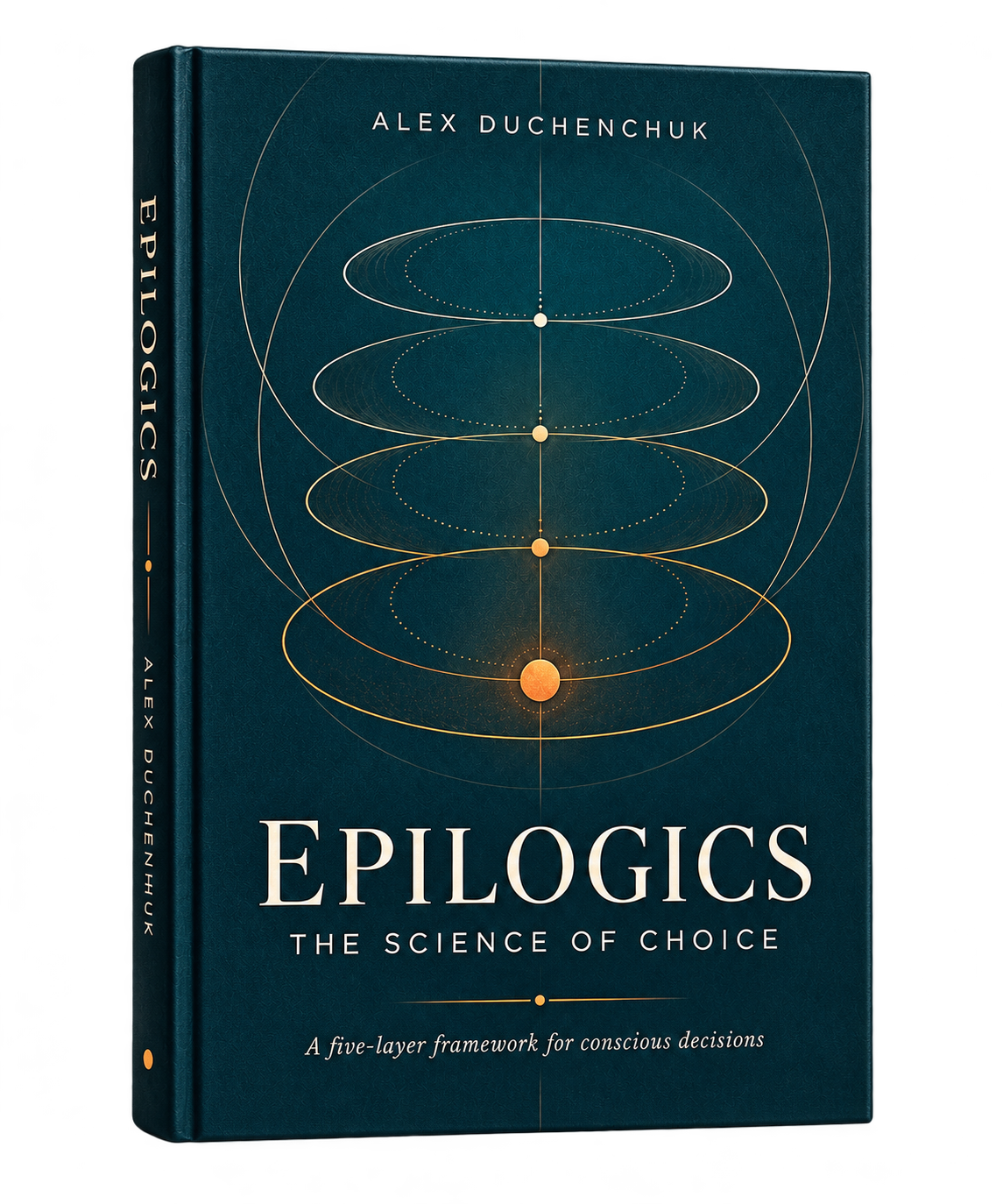
These questions shape the longer work in progress, Epilogics. If you are thinking about them too, I would like to hear how they look from where you stand.
Filed underSovereignty